

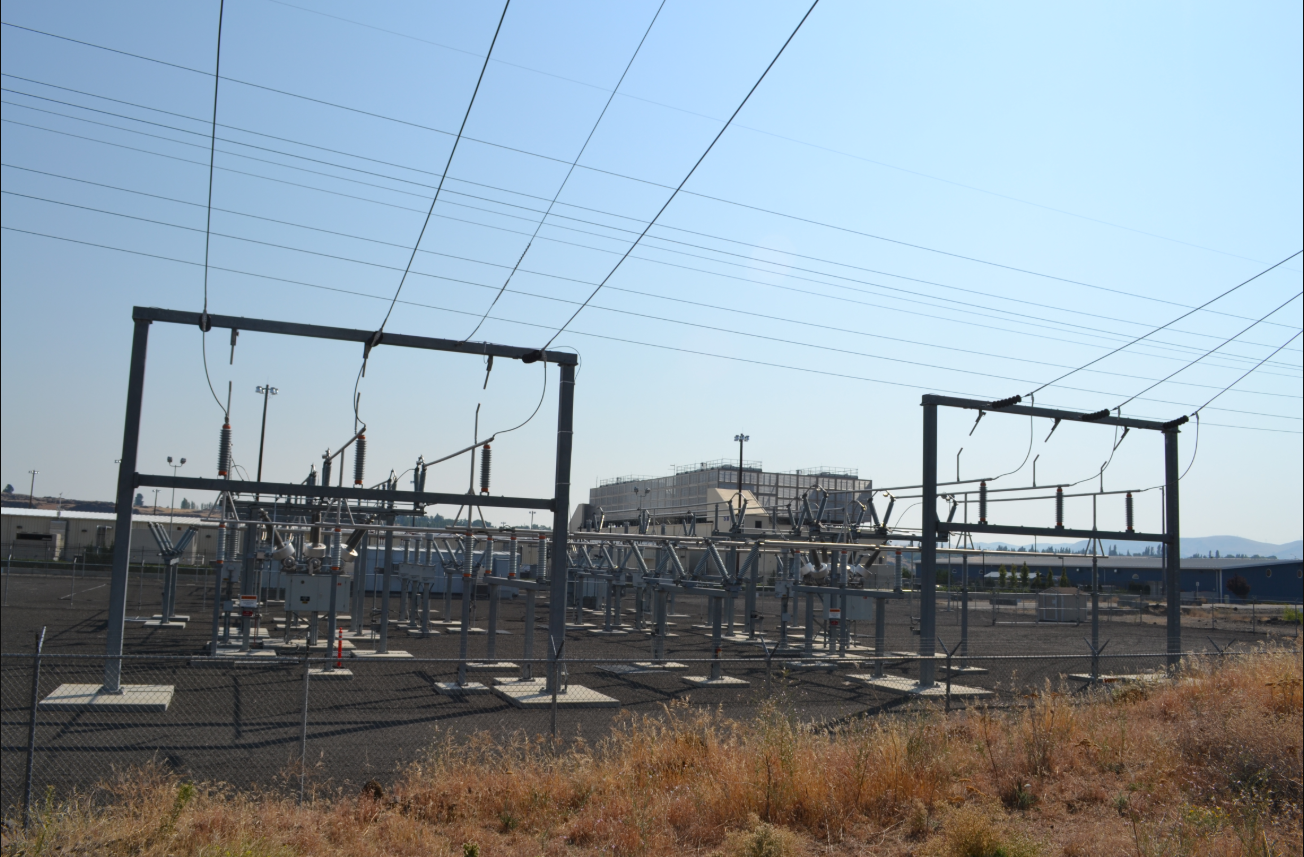
Source: Wikimedia Commons
I scan The New York Times more or less daily. Today, one piece I read featured science writer David Wallace-Wells opining on how deep the opposition to AI data centers in the US is.
Wallace-Wells quoted activist Saul Levin, who hosts a podcast called “The Hum”: “Data centers are a physical manifestation of so many things that people are upset about in our day-to-day lives,” Levin said. “It’s not a fight about technology. This is a fight about control. This is about who controls the future.”
It’s true that data centers are a physical thing localities can assert local control over. And Wallace-Wells named a number of examples of how fierce the opposition has been. It’s a good thing that the public is actually asserting the control they have.
Earlier this year, the Gallup organization conducted its first poll on local AI data centers. Their findings, even for a poll conducted back in March, weren’t surprising. The opposition is solid.
“Seven in 10 Americans oppose constructing data centers for artificial intelligence in their local area, including nearly half, 48%, who are strongly opposed. Barely a quarter favor these projects, with 7% strongly in favor.”
– Gallup poll result reported on May 13, 2026

The overlooked tech question
Activist Levin is wrong about one thing: The AI data center fight is about technology. It’s about how the technologists behind so-called AI data centers are defining AI – in quite a narrow way. By doing so, these technologists have unwittingly triggered a public backlash.
These proponents of AI data centers are narrowly focused on statistical machine learning. The AI data centers in question are designed entirely for the purpose of very large-scale statistical machine learning for Large Language Models (LLMs). This machine learning requires extremely energy dense racks with the most expensive and heat-generating GPUs. Thus the need for water-cooled racks.
But a good portion of these data center plans wouldn’t really require huge GPUs or water-cooled racks if AI data centers supported a hybrid architecture. Even with semantic graph databases carrying some load, transactional relational databases would be able to carry 70 to 80 percent of the total.

| Data center type | Frontier AI rack (NVIDIA GB200 NVL72) | Standard database rack (enterprise) |
| How It Solves Problems | Predicting the next word: Re-reads massive mathematical formulas across billions of parameters to construct an answer. | Looking up the answer: Reads the exact fact directly from memory, such as checking an index, for example. |
| Power Needed Per Cabinet | Massive power: ≈120 kW per cabinet (equivalent to running about 80 to 100 typical homes worth of electricity in one closet-sized space). | Standard power: ≈10–15 kW per cabinet (similar to running a few large home central air units). |
| How It Is Cooled | Plumbed liquid cooling: Piped coolant runs directly over the chips inside the rack because fans cannot move heat fast enough. | Standard room air conditioning: Basic fans blow cool air through the front and exhaust warm air out the back. |
| Water Waste & Use | High risk of local water loss: Many facilities use outdoor evaporative cooling towers that turn thousands of gallons of water into steam every day. | Zero local water lost: Uses simple closed radiator-style fans that don’t evaporate water into the air. |
| Building & Plumbing Setup | Complex and expensive: Requires specialized internal plumbing, pumps, fluid monitors, and leak-prevention systems inside the building. | Standard plug-and-play: Fits into standard enterprise server rooms without custom pipes or special construction. |
| Work Needed Per Question | Trillions of heavy math steps: Burns significant energy generating words one by one. | Single-step lookup: Finds the fact in a split-second with almost no energy spent. |
The AI data center proponents are displaying their own ignorance about diverse data center architecture and the choices that are available.
Hybrid AI: A more practical approach to data center buildout
In this blog, I talk a lot about hybrid AI, the kind that harnesses the power of good, old query languages and direct database retrieval. That’s traditional, symbolic AI used in conjunction with LLMs. Academics call the hybrid neurosymbolic AI because it blends neural networks (statistical deep learning using weights in N-dimensional network models) with symbolic AI.
Agents with the help of Model Context Protocol (MCP) and associated tooling opt to answer questions using traditional symbolic methods. If the user is asking about a known known of the kind that’s been in the business database historically, traditional direct database retrieval should be the default.
Back in 2023, Denny Vrandečić asked a rhetorical question at the Knowledge Graph Conference in 2023. The question he asked continues to be relevant, particularly considering the data center dispute:
“Why would you ever use a 96-layer, 156 billion parameter large language model to do multiplication, when that’s something you can do in a single operation on your CPU?”
Later on, Vrandečić pointed out that “You can use machine learning to retrieve Obama’s birthplace every time you need it, but it costs a lot, and you’re never sure it’s correct.”
As long as we keep using a narrowly defined, expensive architecture for question answering that can happen using traditional architecture that costs comparatively little (pennies on the dollar), we’ll be overspending on AI and on the energy, water and other resources needed for data centers. Instead, let’s use AI intelligently with a blended approach to architecture. That way, we’ll know we’re matching the right computational means with the complexity of the question.
Bibliography
AFCOM, “State of the Data Center 2026 Executive Summary,” AFCOM, February 25, 2026, https://afcom.com/news/720973/WHITEPAPER–State-of-the-Data-Center-2026-Executive-Summary.htm.
Graphwise. The Enterprise Semantic Backbone: A Foundation for Reliable and Scalable Agentic AI. White Paper. New York: Graphwise, 2026. https://graphwise.ai/resources/white-paper/the-enterprise-semantic-backbone-a-foundation-for-reliable-and-scalable-agentic-ai/.
Hewlett Packard Enterprise and NVIDIA Corporation, Deploying NVIDIA GB200 NVL72 at Scale: Power, Direct-to-Chip Thermal Systems, and Facility Requirements, white paper (Houston, TX: HPE / Santa Clara, CA: NVIDIA, 2025), https://www.hpe.com/psnow/doc/a50009224enw.pdf.
Jeffrey M. Jones, “Americans Oppose AI Data Centers in Their Area,” Gallup, May 13, 2026, https://news.gallup.com/poll/709772/americans-oppose-data-centers-area.aspx.
Vrandečić, Denny. “The Future of Knowledge Graphs and Large Language Models.” Keynote address at the Knowledge Graph Conference, 2023. https://www.youtube.com/@KnowledgeGraphConference.
Wallace-Wells, David. “Americans Hate Data Centers. Why?” The New York Times, August 31, 2026. https://www.nytimes.com/2026/08/31/opinion/data-centers-ai-populism.html.


Leave a Reply